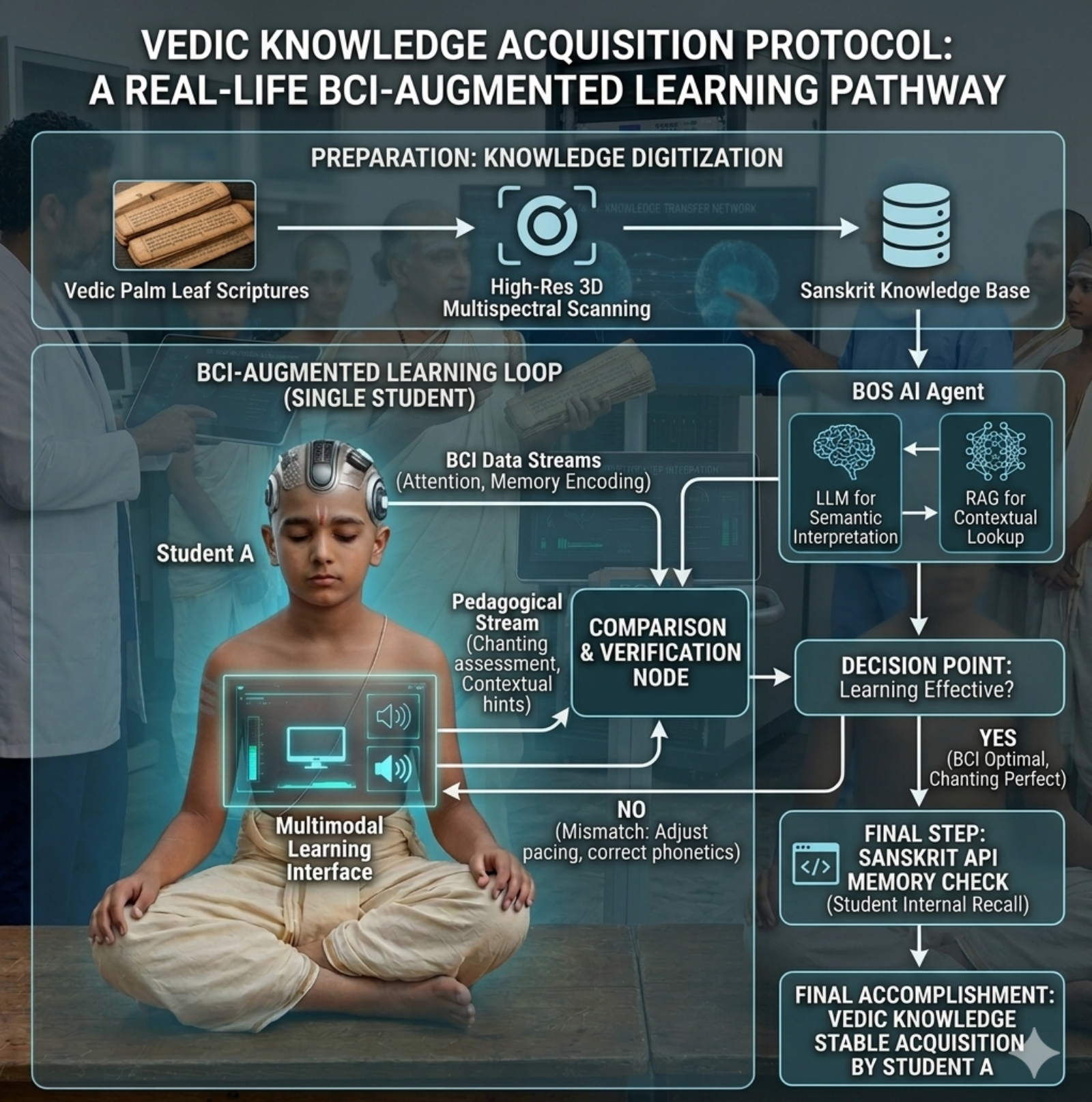
brain-to-brain “Data” – Knowledge Transfer System — a device that can:
Read neural patterns from one brain
Decode learned knowledge/memory
Convert it into transferable representations
Write or stimulate equivalent neural patterns into another brain
This combines multiple fields:
Vedic Sciences
Neuroscience
BOS alternative to Brain–Computer Interface
Maths
Artificial Intelligence
Cognitive Science
Neural Engineering
Sanskrit linguistics,
Robotics,
Neuro sciences
Data Science Engineering,
Space Science technologies
Deep Learning,
Atomic Science,
Biotechnology,
Autonomy
Today, full memory transfer is NOT possible with existing technology.
But partial forms already exist:
Brain signal reading
Motor intention decoding
Neural stimulation
Prosthetic memory experiments
Brain-to-brain communication of simple signals
the current project is scientifically visionary, but it would require several technological breakthroughs.Lorem ipsum dolor sit amet, at mei dolore tritani repudiandae. In his nemore temporibus consequuntur, vim ad prima vivendum consetetur. Viderer feugiat at pro, mea aperiam
1. Reality Check — What Is Actually Stored in the Brain?
A 12-year Vedic education is not stored like files in a hard disk.
The knowledge exists as:
Synaptic strengths
Neural firing patterns
Temporal activation networks
Emotional/contextual associations
Auditory rhythm memory
Long-term plasticity
The “data” is distributed across billions of neurons.
A Vedic student may use:
Language regions
Auditory cortex
Motor speech systems
Memory systems
Emotional reinforcement systems
So the challenge is:
You are not transferring words.
You are transferring an entire neural structure.
2. Existing Technologies Relevant to Your Vision
A. Brain Reading Technologies
1. EEG (Electroencephalography)
Reads electrical activity from scalp.
Current capability:
Detect attention
Meditation
Simple intentions
Limitation:
Very low resolution
Used by:
Neuralink
MIT
2. fMRI
Measures blood flow linked to brain activity.
Can:
Roughly reconstruct viewed images
Detect semantic categories
Limitation:
Slow
Huge machines
Not portable
3. ECoG / Neural Implants
Electrodes placed directly on brain.
Can:
Decode speech attempts
Control robotic arms
Decode motor intentions
This is currently the closest technology to your vision.
B. Brain Writing Technologies
1. TMS (Transcranial Magnetic Stimulation)
Magnetic stimulation changes brain activity.
Can:
Alter mood
Enhance learning temporarily
Cannot:
Upload memories
2. Deep Brain Stimulation
Used for:
Parkinson’s disease
Tremor control
Still primitive for memory writing.
3. Optogenetics
Controls neurons using light.
Powerful in animals.
Requires:
Genetic modification
Potential future technology for memory writing.
3. Existing Scientific Experiments Similar to Your Idea
Experiment 1 — Brain-to-Brain Communication
Researchers transmitted simple signals between brains:
One person thinks about moving hand
Signal transmitted
Another person’s hand moves
This is extremely primitive.
Experiment 2 — Memory Prosthetics
Researchers implanted devices in animals to:
strengthen memory formation
reproduce learned signals
Partial success in rats.
Experiment 3 — AI Reconstruction of Thoughts
AI models can reconstruct:
rough images
words
semantic categories
from brain scans.
Still nowhere near “knowledge transfer.”
4. Main Scientific Problems You Must Solve
Problem 1 — Neural Encoding
We still do not fully understand:
How exactly a memory is represented.
This is the biggest challenge.
Problem 2 — Individual Brain Differences
Every brain is unique.
The same Sanskrit mantra may have different neural representation in two people.
So direct copying may fail.
Problem 3 — Writing Memories
Reading signals is easier.
Writing precise neural states is far harder.
You would need:
neuron-level precision
timing precision
plasticity control
Problem 4 — Conscious Integration
Even if data is inserted:
Will the person understand it?
Will it feel natural?
Will it integrate with identity?
Unknown.
5. Future Technologies Needed
To achieve your vision, humanity likely needs:
A. Whole Brain Mapping
A complete connectome.
Meaning:
map every neuron
map every synapse
For reference:
Human brain ≈ 86 billion neurons
Needed technologies:
nanoscale scanners
quantum neural imaging
molecular mapping
B. Neural Code AI
AI that can translate:
Brain A pattern → abstract knowledge representation → Brain B pattern
This requires:
superhuman AI
massive neuroscience datasets
C. Neural Writing Interface
Future device capable of:
targeted neuron stimulation
synaptic rewriting
plasticity modulation
Possibly using:
nanobots
optical neural meshes
bioelectronic interfaces
D. Brain Digital Twin
A digital simulation of a person’s neural structure.
Could allow:
memory extraction
memory compression
knowledge transfer
6. Architecture of Your Proposed System
Here is a conceptual architecture.
FLOW CHARTLorem ipsum dolor sit amet, at mei dolore tritani repudiandae. In his nemore temporibus consequuntur, vim ad prima vivendum consetetur. Viderer feugiat at pro, mea aperiam
+————————————————+
| VEDIC STUDENT (SOURCE BRAIN) |
+————————————————+
|
v
+————————————————+
| Neural Signal Capture System |
| – EEG / ECoG / Neural Implants |
| – Synaptic Activity Recording |
+————————————————+
|
v
+————————————————+
| AI Neural Decoder |
| – Pattern Recognition |
| – Memory Extraction |
| – Semantic Compression |
+————————————————+
|
v
+————————————————+
| Knowledge Representation Engine |
| – Converts neural patterns |
| into transferable structures |
+————————————————+
|
v
+————————————————+
| Neural Translation Layer |
| – Maps Source Brain |
| to Target Brain Architecture |
+————————————————+
|
v
+————————————————+
| Brain Writing System |
| – Neural Stimulation |
| – Synaptic Reconfiguration |
| – Memory Implantation |
+————————————————+
|
v
+————————————————+
| TARGET BRAIN |
+————————————————+
7. More Realistic Near-Term Version
Instead of “direct memory transfer,” a practical version would be:
AI-Assisted Accelerated Learning
The system could:
monitor expert brain states
detect learning patterns
guide another learner
Example:
student wears neural headset
AI compares student brain state with expert
AI adapts teaching in real time
This is much more achievable in the next 10–20 years.
8. Development Roadmap
Phase 1 — Current Technology (0–5 years)
Goal:
Read and classify brain patterns
Build:
EEG systems
AI pattern recognition
Sanskrit chanting recognition
Technologies:
EEG
ML models
Transformer AI
Neural signal processing

